
Gastonia vs. Charlotte: Where Should You Buy Your Next Rental?
The Charlotte metropolitan area in North Carolina continues to be one of the Southeast’s strongest growth stories, but savvy rental property investors are increasingly looking beyond the urban core. Gastonia, a key city in Gaston County just west of Charlotte, offers a compelling alternative for those seeking better cash flow, lower entry costs, and solid long-term potential in the same booming region.
This extensive comparison examines key factors for rental investors: purchase prices, rental yields, market dynamics, tenant demand, operating costs, appreciation potential, lifestyle/amenities, risks, and practical advice for deciding where to buy your next investment property.
Market Overview and Pricing (Mid-2026)
Charlotte (and broader metro):
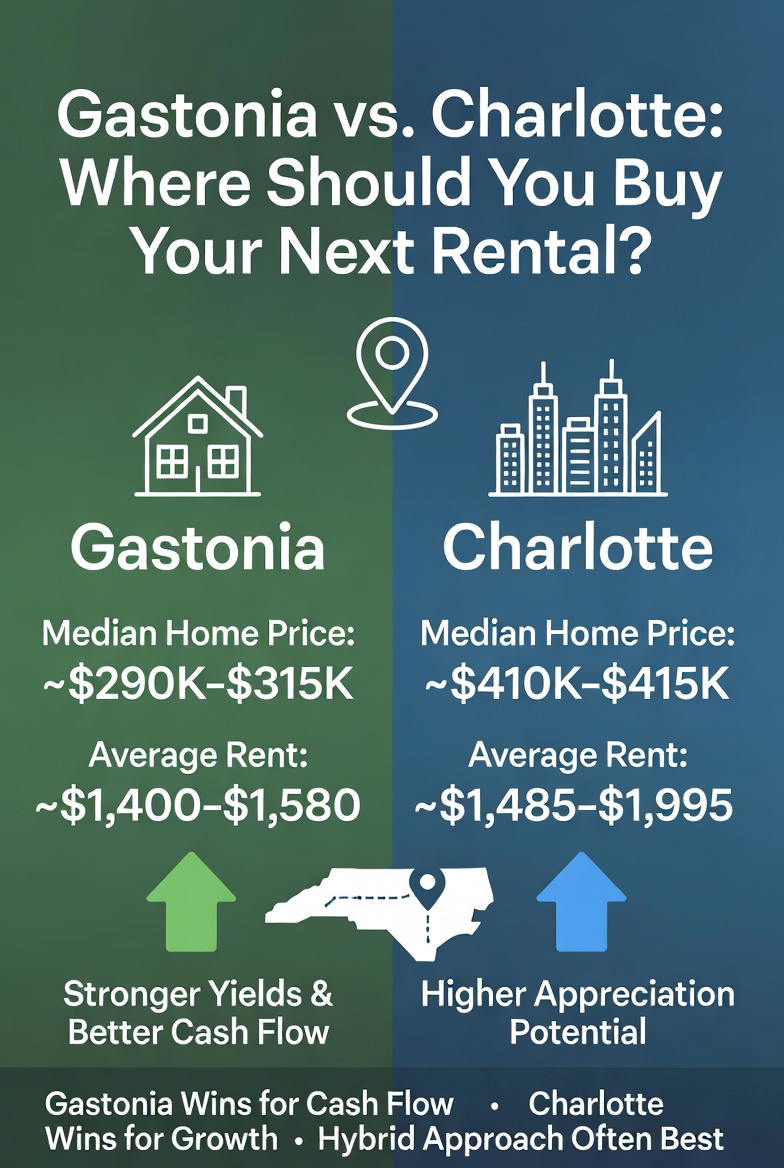
- Median home/listing prices in the Charlotte-Concord-Gastonia metro hover around $410,000–$415,000.
- Average home values around $390,000–$400,000 in recent data, with some stabilization or slight softening after prior rapid gains.
- Homes in desirable neighborhoods (e.g., South End, NoDa, Ballantyne) command premiums, often well above metro medians.
Gastonia:
- Average home values around $280,000 (Zillow data), with median listing/sale prices in the $290,000–$315,000 range.
- This represents a significant discount—often $100,000–$150,000+ less than comparable properties in Charlotte proper—allowing investors to acquire larger homes, multi-family units, or better-conditioned properties for the same capital.
Key takeaway on entry costs: Gastonia offers a much lower barrier to entry, making it easier to scale a portfolio or achieve positive cash flow sooner, especially with current mortgage rates.
Rental Market and Cash Flow Potential
Rents:
- Metro/Charlotte area: Median asking rents around $1,485 (early 2026 data), with city averages often cited at $1,480–$1,995 depending on source and property type. Rents have seen slight declines or stabilization amid increased supply.
- Gastonia: Typical rents around $1,400–$1,580, with some reports showing averages as low as $1,173 for apartments but higher for single-family homes. Rents remain notably below Charlotte but have shown year-over-year growth in demand areas.
Yields and Cap Rates:
- Gastonia generally delivers stronger rental yields and higher cap rates (e.g., median around 4.3% in some analyses) due to the lower purchase prices relative to rents. It is often positioned as a “value play” with attractive cash-on-cash returns.
- Charlotte offers solid demand but faces more competition and higher prices, which can compress yields (price-to-rent ratios often higher). Cash flow is tighter on single-family rentals in core areas, though multi-family or specific submarkets can perform well.
Vacancy and Stability:
- Charlotte metro vacancy rates are balanced (around 6.4%), with healthy demand from population influx.
- Gastonia benefits from spillover demand as people priced out of Charlotte seek affordability while commuting. Turnover can be lower in family-oriented areas.
Bottom line on cash flow: Gastonia typically wins for immediate positive cash flow and higher yields on single-family rentals. Charlotte may excel for investors prioritizing scale, appreciation, or premium properties with professional tenants (e.g., finance/tech workers).
Demographics, Population Growth, and Tenant Demand
Charlotte Metro (including Gastonia):
- Population ~2.77 million, with strong ongoing growth (e.g., ~157 people moving to the region daily in recent reports).
- Diverse economy: Finance, healthcare, manufacturing, retail, tech. Median household income ~$83,000.
- Attracts young professionals, families, and corporate relocations.
Gastonia specifically:
- Population ~85,000–88,000 (city), part of growing Gaston County (~240,000+). Steady growth at ~1.5% annually.
- Median household income ~$64,000; more affordable, blue-collar and manufacturing base with spillover from Charlotte jobs.
- Growing appeal for families and commuters seeking lower costs.
Tenant pools: Both have strong demand, but Charlotte draws higher-income renters willing to pay premiums in urban/suburban hotspots. Gastonia appeals to cost-conscious families, young households, and commuters, with solid stability for long-term rentals.
Cost of Living, Operating Expenses, and Taxes
- Gastonia’s overall cost of living is notably lower than Charlotte’s (Charlotte ~13.7% more expensive in some comparisons), particularly for housing.
- Property taxes, insurance, and maintenance tend to be lower in Gastonia, boosting net yields.
- Charlotte has higher property values (and thus taxes) but also potentially higher appreciation and rent growth in prime areas.
Appreciation Potential and Long-Term Outlook
Charlotte has seen stronger historical price growth and benefits from major infrastructure, corporate presence, and urban revitalization. It remains a primary growth engine.
Gastonia offers more moderate but steady appreciation, with upside from regional growth, new development, and proximity to Charlotte (about 20–25 minutes to Uptown). It’s positioned for “catch-up” gains as the metro expands westward.
Investors focused on total returns (cash flow + appreciation) may blend both: core Charlotte for growth and Gastonia for yield.
Pros and Cons Summary
Charlotte Pros:
Strong job market, population growth, and amenities.
Higher potential for property appreciation and premium rents.
Diverse tenant pool (professionals, families).
Vibrant urban/suburban lifestyle attracting residents.
Charlotte Cons:
- Higher purchase prices and competition from investors.
- Tighter cash flow margins.
- Potential for oversupply in some rental segments leading to rent softening.
Gastonia Pros:
- Significantly lower entry prices → better cash flow and scalability.
- Favorable yields and rental demand from affordability seekers.
- Lower operating costs.
- Less investor saturation; more “value play” opportunities.
- Proximity to Charlotte without the premium.
Gastonia Cons:
- Slower appreciation than core Charlotte.
- Perception/image challenges in some areas (though improving).
- Tenant demographics may skew toward more price-sensitive renters.
- Fewer high-end amenities compared to Charlotte.
Other Factors: Schools, Crime, Amenities, and Quality of Life
- Charlotte: World-class amenities, airports, sports, dining, culture, and top schools in certain suburbs. Higher density and traffic.
- Gastonia: More affordable family-friendly environment, parks, growing retail/revitalization efforts, and easy access to Charlotte’s offerings. Schools and community vary by neighborhood—due diligence is key. Lower density appeals to many renters.
Crime and safety perceptions differ by specific submarkets in both cities; always review local data and visit properties.
Who Should Buy Where?
- Choose Gastonia if: You prioritize cash flow, higher cap rates, portfolio scaling on a budget, or targeting working families/commuters. Ideal for buy-and-hold investors seeking steady income with regional growth tailwinds.
- Choose Charlotte if: You want maximum appreciation, prestige locations, professional tenants, or are playing the long game in a major metro. Better for those with more capital or who can leverage strong management.
- Hybrid approach: Many successful investors own in both—using Gastonia for yield and Charlotte for growth.
Practical Advice for Investors
- Run the numbers: Use local comps for realistic rents, vacancies (aim for 5–8%), expenses (property taxes, insurance, maintenance ~1% of value annually), and financing.
- Location matters: In Gastonia, focus on growing or revitalizing neighborhoods. In Charlotte, target stable or up-and-coming submarkets.
- Property types: Single-family homes dominate both for rentals; consider duplexes/triplexes for better cash flow.
- Due diligence: Inspect thoroughly, review HOA rules (if any), check flood zones, and consult local property managers.
- Management: Professional management is highly recommended, especially if not local. Gastonia may have lower turnover.
- Financing and taxes: Explore investor loans; consult a tax advisor on depreciation, 1031 exchanges, etc.
- Market timing: Both markets are relatively balanced in 2026, with opportunities in a post-boom stabilization phase.
Final Verdict
There is no universal “winner”—it depends on your investment goals, risk tolerance, and capital. Gastonia often edges out for pure rental cash flow and affordability, making it an excellent choice for many investors looking to build wealth through income. Charlotte shines for long-term appreciation and lifestyle-driven demand in a dynamic major city.
The Charlotte region as a whole remains investor-friendly due to sustained growth. Serious buyers should tour both markets, analyze specific properties with current data, and consider consulting local real estate professionals or property managers.
Whether you go urban-core or value-suburb, the key is buying fundamentally sound properties in areas with enduring demand. Happy investing in the Carolinas!